WHAT
Marriage, Orthodoxy and a Vision of Empowerment – or MOVE – is a first-of-its-kind research and advocacy project. Co-led by survivors, MOVE is exploring and challenging dominant understandings of forced marriage, forced marital sex and forced parenthood in the United States, and dismantling the structures that support and enable these practices, through a case study of the Orthodox Jewish community in New York City. MOVE also is correcting the simplistic way this community and its marital practices have been represented.
WHO
MOVE is spearheaded by:
- Columbia University researchers – led by Prof. Jennifer S. Hirsch, one of the nation’s leading researchers working at the intersection of gender, sexuality and health; and
- Unchained At Last, the survivor-led nonprofit determined to end forced and child marriage in the U.S. – helmed by founder/executive director Fraidy Reiss, who survived forced marriage, forced marital sex and forced parenthood in New York City’s Orthodox Jewish community.
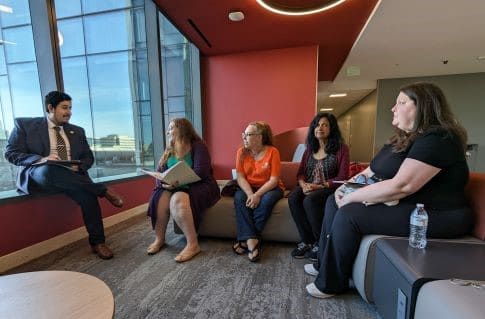
Employing a community-based participatory research approach, the Columbia and Unchained teams are collaborating with an action committee comprised of grassroots activists – most of whom are survivors of forced marriage – who address gender inequality and sexual violence inside the Orthodox Jewish community. The action committee acts both as advisers, helping to design and lead the study, and as a key audience for study findings, which they will use to generate dialogue and create pathways for change from within.
Members of the action committee include representatives of Footsteps, Jewish Orthodox Feminist Alliance, Mavar, Nahamu, Yaffed, Yeshivat Maharat and others.
MOVE is made possible by the New York Community Trust, the Valentine Perry Snyder Fund, the Russell Berrie Foundation, the New York Women’s Foundation and other generous funders.
WHY
The United States is not on track to keep its promise, under the United Nations Sustainable Development Goals, to end forced marriage by year 2030.
The U.S. has done little to address, study or even acknowledge this harmful practice, which is recognized as a form of modern slavery. The resulting misconceptions of the extent, contexts and impacts of forced marriage in the U.S. leave the nation unable to understand it fully, let alone eliminate it.
MOVE is examining New York’s Orthodox Jewish community, whose resistance to change sometimes puts its laws and customs in contradiction with state and federal laws and broader American norms regarding marital and sexual consent. MOVE is arming grassroots activists inside the Orthodox Jewish community with the data they need to effect change, as it also aims to launch a long-overdue national conversation about marital, sexual and reproductive self-determination in all American communities.
Ultimately, MOVE’s goal is to get the U.S. to keep its promise to the world and eliminate forced marriage by the end of the decade.
HOW
MOVE’s research includes conducting in-depth one-on-one interviews and focus groups with individuals who were married in the Orthodox Jewish community in or near New York City, to explore the full range of marital experiences. The research also includes interviews with key experts about current structures, conflicts with New York and U.S. law and possible pathways to change; analysis of the community’s publications; and participant observation.
MOVE’s advocacy includes disseminating the findings in the Orthodox Jewish community and across the U.S.; preparing and supporting the action committee members to meet with rabbinical leaders and propose reforms; and partnering with policymakers to find policy solutions at the local, state and national levels.
WHEN
MOVE is a multi-year project. Key milestones to date include:
- January 2026: Jennifer Hirsch, lead MOVE researcher, secures a contract with Princeton University Press for a forthcoming book about MOVE that will introduce the concept of “intimate self-determination” and examine how religious, legal and economic structures shape marriage, sex and consent.
- December 2025: The MOVE team publishes their first journal article, “Forced marriage, divorce, and the ecology of marital self-determination: findings from research with Orthodox Jews in New York,” in SSM – Mental Health. The paper shows why policymakers and others must recognize barriers to divorce, not just coerced entry into marriage, as part of the human rights abuse that is forced marriage.
- October 2025: The MOVE team starts talking to New York legislators about policy recommendations based on research findings.
- January 2025: The MOVE team disseminates some of its topline findings in English and Yiddish.
- January 2025: The MOVE team’s article titled “Missing Pieces,” published in the Journal of Family Theory & Review, points out glaring gaps in existing research on forced marriage. The article shows that researchers must move beyond assumptions that forced marriage happens only to cisgender heterosexual women from “backwards cultures.”
- December 2024: The MOVE team completes data collection and moves on to the advocacy phase. To date, the MOVE team has:
- Interviewed more than 80 current and former members of New York City’s haredi community about their marital experiences;
- Spent some 80 hours conducting participant observation and interviewing key experts; and
- Met with six rabbinical authorities to identify possible reforms.
- November 2024: Two members of the MOVE team present about the project at the American Anthropological Association annual meeting in Tampa, one about the weaponization of family law and one about forced reproduction and limited access to contraceptives.
- September 2024: Lead MOVE researcher Prof. Jennifer Hirsch is selected for the prestigious Radcliffe Fellowship at Harvard University, where she joins exceptional scientists, writers, scholars, intellectuals and artists whose work is making a difference in their fields and the larger world. She plans to devote 80% of her time during the one-year fellowship to coordinating with the MOVE action committee and writing a book about MOVE.
- August 2024: Unchained’s Fraidy Reiss, co-leader of MOVE, “stars” in a Shtetl podcast, by and for the Orthodox Jewish community, and describes her abusive forced marriage in the community.
- August 2024: MOVE researcher Prof. Jessie Ford of Columbia University presents about MOVE at the American Sociological Association annual meeting in Montreal.
- April 2024: Prof. Jennifer Hirsch, lead MOVE researcher, presents an overview of MOVE’s preliminary findings to an interdisciplinary audience of 75 researchers at the Population Association of America annual meeting in Ohio.
- January 2024: Unchained’s founder/executive director Fraidy Reiss’ harrowing account of her forced marriage, forced marital sex and forced parenthood, published in HuffPost, gets hundreds of thousands of views — as part of MOVE’s strategy of raising awareness.
- October 2023: Columbia University’s Institute for Religion, Culture and Public Life hosts an invite-only MOVE launch event, at which the MOVE team shares preliminary findings and seeks input from experts, activists, survivors and other allies.
- April 2023: The MOVE team starts conducting in-depth interviews, focus groups and key-expert interviews.
- February 2023: MOVE gets Institutional Review Board approval to begin.
Questions about MOVE? Contact Unchained.